Snippet
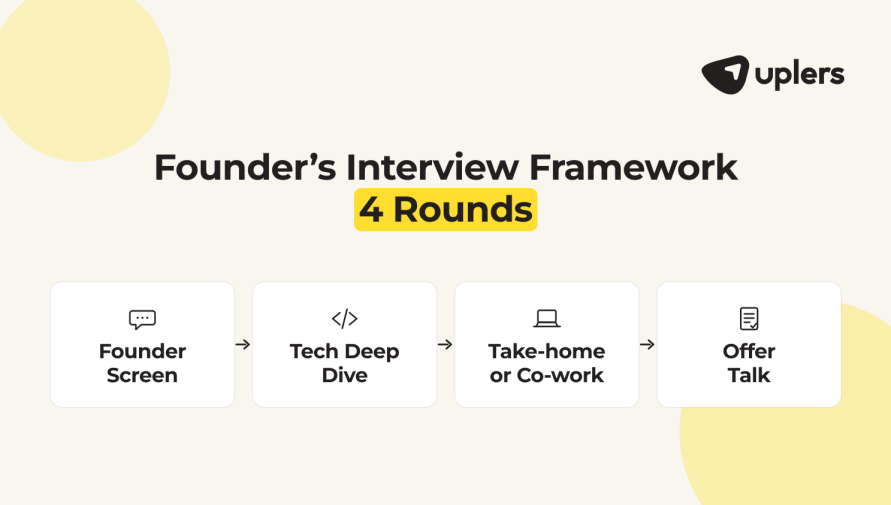
- It runs in 4 rounds: a 30-min founder screen, a technical deep dive, a short take-home (max 4 hours) or paid co-working, and a direct offer conversation.
- Want to know if someone can actually build? Go deep on one real project they owned and ask what broke in production, and what they deliberately chose not to build.
- And here is the part most founders get wrong: speed. First contact to offer in 2 to 3 weeks, or you lose good people to delay. Good candidates are juggling other offers.
Startup hiring is different and the way you interview has to match that. Here is the framework we use and recommend.
The Interview Framework: 4 rounds
- Round 1, the screen: a 30 minute founder call focused entirely on soft skills, ownership and how comfortable the person is when nobody is telling them what to do next.
Work out basic details on comp and logistics here so that they don’t become a reason for a no-show at the end. - Round 2, the tech interview: a technical deep dive run by a VP or technical co-founder, someone with the depth to actually judge the answers.
Dig into stuff from their resume and application. You want to know how they think, not just what they do. - Round 3, the take-home: a practical task of not more than 4 hours that tests logical reasoning through a real walkthrough, scheduled around their current job.
If possible, have them actually work on a weekend with you or a couple of days when convenient and pay them for that. See them solve real problems live.
A note here – If it is an assignment, don’t give them more than 4 hours to finish. If it is co-working with you then extend it to a couple of days as feasible. - Round 4, the negotiation: you and whoever they will report to talk them through the offer directly.
Now some extra notes: How to run the interviews
What should you actually look for when hiring for a startup? Here is what actually tells you if someone is ready for a startup, in 3 parts.
Part 1
In the interview, go deep on 1 real project they owned. Independent or inside an organization, does not matter. Pick something they claim they built, and dig in.
- What did you build first, and why that?
- What broke in production? How did you find out? What did you do?
- What did you deliberately not build?
- If you rebuilt it today, what would you change?
Part 2
Hand them a vague problem. Something like, “users need to do X. You have 2 weeks. You are the only engineer. What do you build?” A strong candidate asks sharp questions, cuts everything that is not essential, and tells you why. A weak one waits for you to spell it out or over builds for a 2-week job.
Part 3
Test their judgment. Ask, “tell me about shipping something you knew was not perfect. Why was that the right call?” Good builders have real scars, and they can walk you through the tradeoff.
Bonus tips
2 things keep the process fast, and fast is what wins you strong candidates. They usually juggle multiple offers at once, so delay loses them.
- Go from first contact to offer in about 2 to 3 weeks.
- Do not let applications sit for a week and interviews sit for another week. Set your timeline before you start, and hold it. Something like this works for most early hires: review applications within two days, first interview within a week, a decision within two weeks.
Speed is not about rushing the judgment. It is about not losing good people to delay.
Wondering if you can get the pulse of whether someone is startup-ready or not while reading their resume? Read this.
Need some help figuring this out? Talk to us, it’s free and the coffee’s on us.